Why sail Brazil
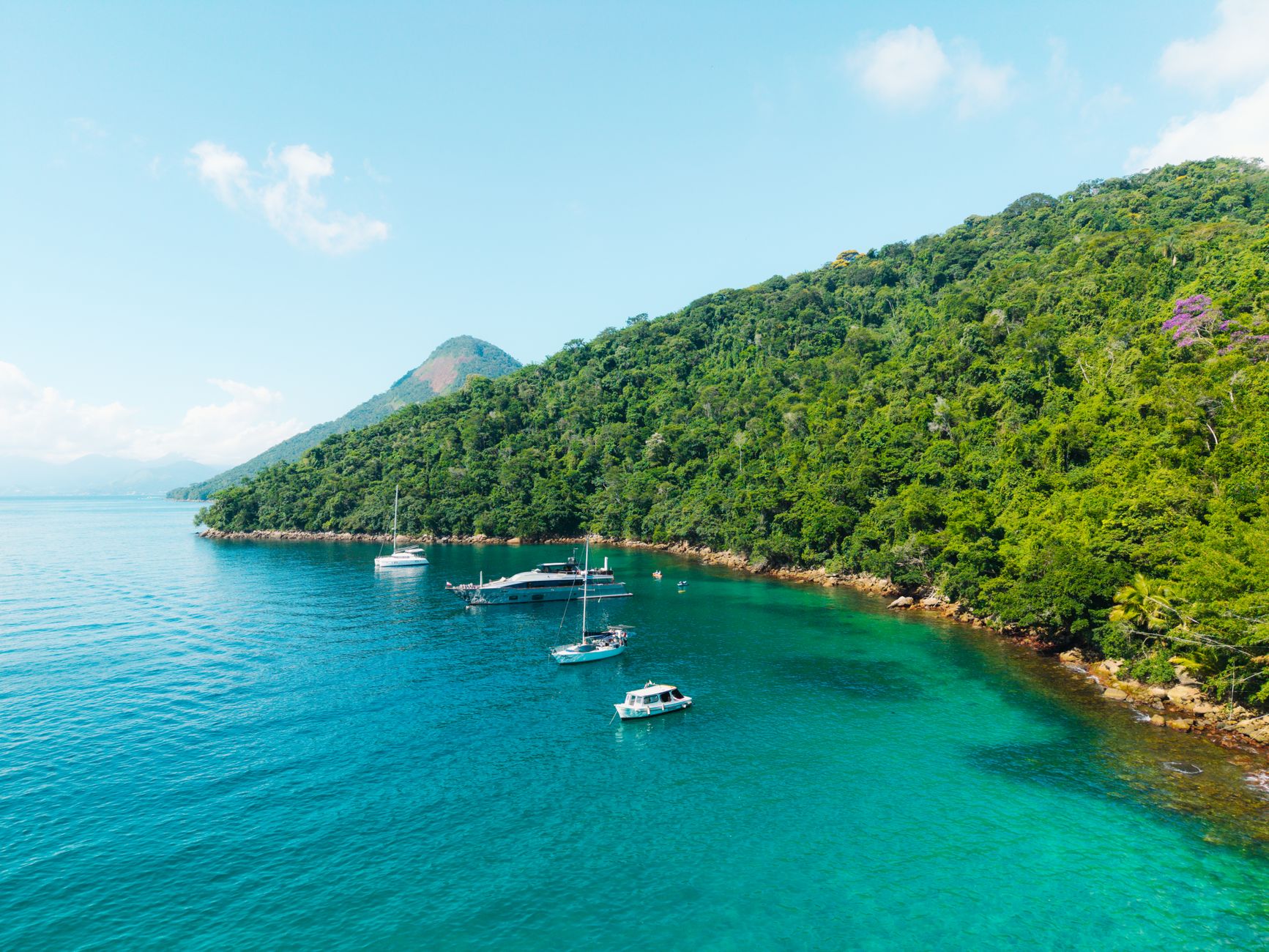
Most of Brazil's coast is beach and surf, not sailing. The Southeast is the exception. Between Rio de Janeiro and Paraty the shoreline folds into a run of protected bays, granite headlands and hundreds of islands — the kind of coast where you can anchor in flat water with the Atlantic swell held off by land. Ilha Grande alone has enough coves for a week. The water runs warm year-round, the forest comes right down to the tideline, and the sailing is short-hop and forgiving rather than open-passage hard. We sail it for the anchorages more than the distances: you rarely need to be under way more than two or three hours to find somewhere new to swim.
The sailing grounds
One cruising area, and a good one: the Costa Verde, the green coast, running roughly from Angra dos Reis west to Paraty. Angra is the practical base — a working town with marinas, provisioning and a straight road from Rio. From there the bay of Ilha Grande opens up: Abraão as the island's main village, Lopes Mendes on the ocean side for the beach, Saco do Céu and Freguesia de Santana for quiet nights at anchor. West along the mainland you reach Paraty, whose colonial centre sits right on the water — cobbled streets that flood at spring tides, a quay you can dinghy up to. The islands in between are close together and mostly forested, part of a protected marine area, so expect clear water and rules on where you can anchor.
Season and winds
Brazil's Southeast is a Southern-Hemisphere summer destination. The best sailing window runs roughly November to March, when the water is warmest and the days longest. Wind here is lighter and less predictable than the Mediterranean or the trades of the Caribbean — you get thermal sea breezes filling in through the afternoon, often from the east or south-east, 8 to 15 knots on a decent day, dropping off at night. Expect to motor between anchorages more than you might elsewhere. Summer also brings afternoon thunderstorms that build over the mountains and clear quickly; they can arrive with a hard squall, so we watch the sky and reef early. Winter (June to August) is cooler and can be grey, with the occasional southerly front pushing through. It's sailable, just less inviting for swimming.
Charter types
We offer skippered charters on the Costa Verde. If you hold recognised sailing qualifications and want to take the helm yourself, tell us your experience and we'll talk through what's possible — bareboat availability and the paperwork vary, so it's a conversation rather than a checkbox. For most guests, a skipper who knows the bay is worth having: local knowledge of the anchorages, the anchoring restrictions inside the marine park, and where the afternoon breeze actually fills makes the difference between a good week and a frustrating one. Crewed options with a cook can be arranged. Half-day and day sails out of Angra are also possible if a full week isn't what you're after — ask us on WhatsApp.
What it costs
Charter cost depends on the boat, the length of the trip, and whether you want crew. As a rough guide, a week's skippered charter on a mid-size monohull in the Costa Verde sits in the low-to-mid four figures in EUR, with larger yachts and catamarans higher. On top of the base rate, budget for fuel (you'll motor a fair bit here), marina and mooring fees, national-park fees, provisioning, and the skipper and any crew. Peak season over the Brazilian summer holidays and around Carnival is dearer and books early. For anything beyond a ballpark, price on request — we'll quote against real dates and a real boat rather than guess. Message us on WhatsApp with your dates and party size and we'll put numbers to it.
A sample week
Day 1: board at Angra dos Reis, provision, and make the short hop across to Ilha Grande, anchoring at Saco do Céu for a calm first night. Day 2: round to Abraão, the island's main village, for a walk and dinner ashore. Day 3: sail the south side to Lopes Mendes — anchor off and dinghy in to the beach, one of the best on the coast. Day 4: work west through the islands toward the mainland, picking a quiet cove for lunch and a swim. Day 5: into Paraty; tie up or anchor off and spend the evening in the old town. Day 6: island-hop back east, no fixed plan, following the breeze. Day 7: last night near Angra, back alongside in the morning. Distances are short, so this is a swim-and-explore week, not a passage.
Getting there
Fly into Rio de Janeiro (either Galeão international or Santos Dumont). Angra dos Reis is roughly a two-and-a-half to three-hour drive west along the Costa Verde road — a private transfer or hire car both work, and the coastal drive is worth doing in daylight. Paraty has its own small airport with limited flights; most people still route through Rio. Brazil requires a valid passport, and depending on your nationality you may need a visa or an entry authorisation, so check your requirements well ahead. Portuguese is the language; English is spoken around the marinas but less so inland. We'll send arrival details and a meeting point once your dates are confirmed.
Who it suits
Right for families, first-time charterers and anyone who wants warm-water anchorages and short hops rather than hard sailing. Less right if you're after consistent big-breeze passage-making — the wind here is lighter and you'll use the engine. Come for the islands, the swimming and the quiet coves, and you won't be disappointed.
Yachts available in Brazil.
No yachts are available right now. Please check back soon, or get in touch and we’ll help you plan your charter.
Brazil questions
Asked and answered.
How much does a yacht charter in Brazil cost?
When is the best time to sail Brazil's Southeast coast?
Where do charters usually start?
Do I need a licence to charter here?
Is Brazil good for a family sailing holiday?
How do I get to the Costa Verde?
Can I do a day sail rather than a full week?
Where can I sail in Brazil?
How many yachts are available in Brazil?
How do I get a quote?
Real people
Talk to a human
A real person reads every message and replies within 24 hours — no bots, no auto-replies.
- Honest advice from sailors, not salespeople
- We reply within 24 hours
- No spam, ever
Talk to an expert
Get three options.
Real sailors who run the trips — tell us your week, your group and your vibe. Same day, we send three boats, three prices and the honest trade-offs. Boats we would put our own families on.
Final boarding call
Why not you?
New sailors, beginners or seasoned skippers — tell us when, where and how many. We send three real options the same day. No spam, no fluff, no commitment.